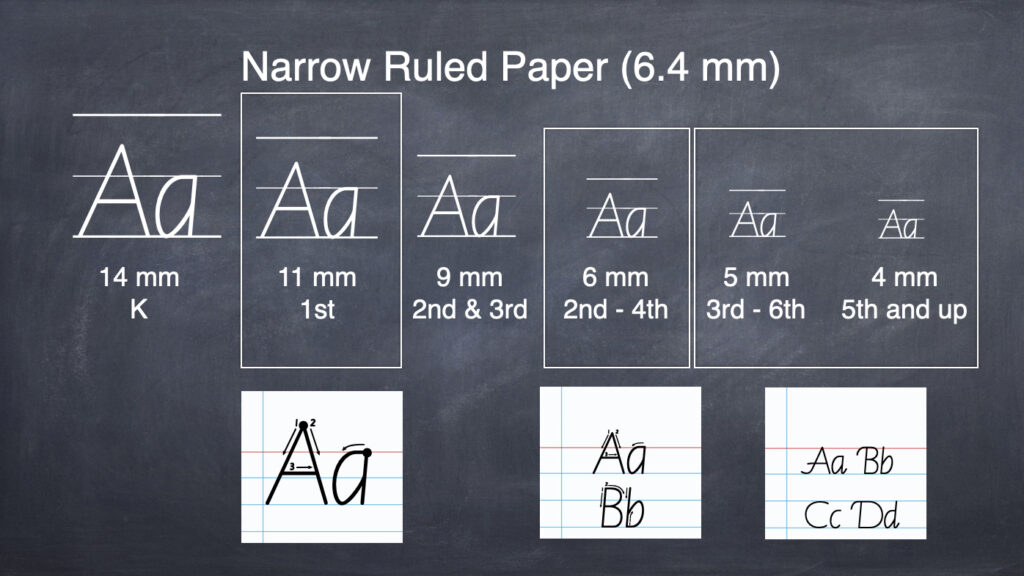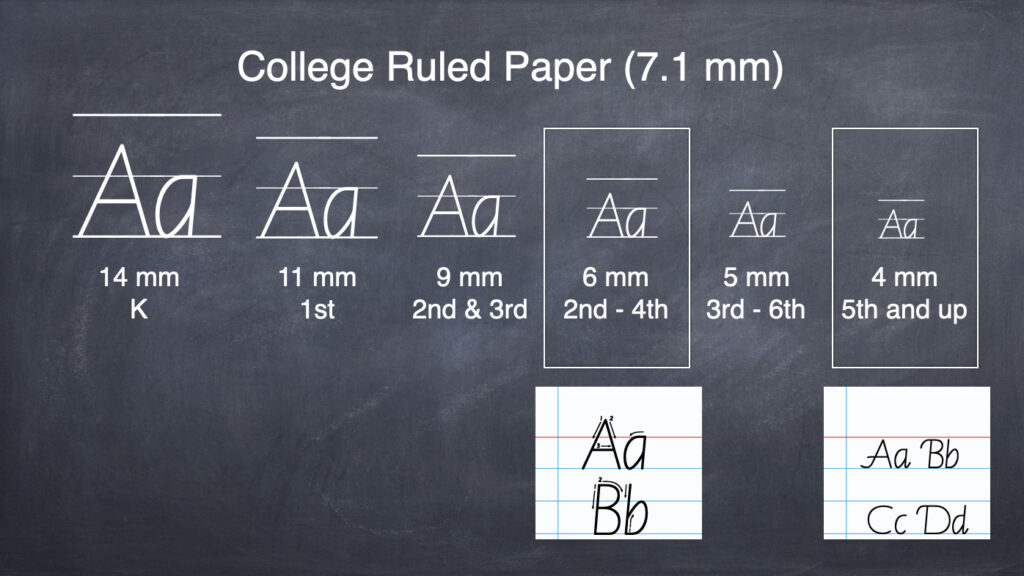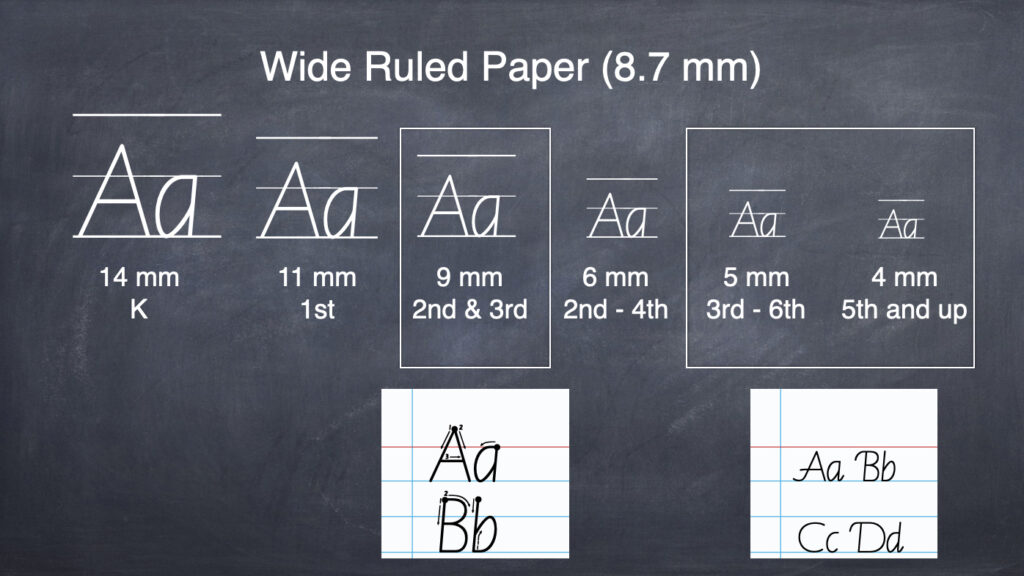
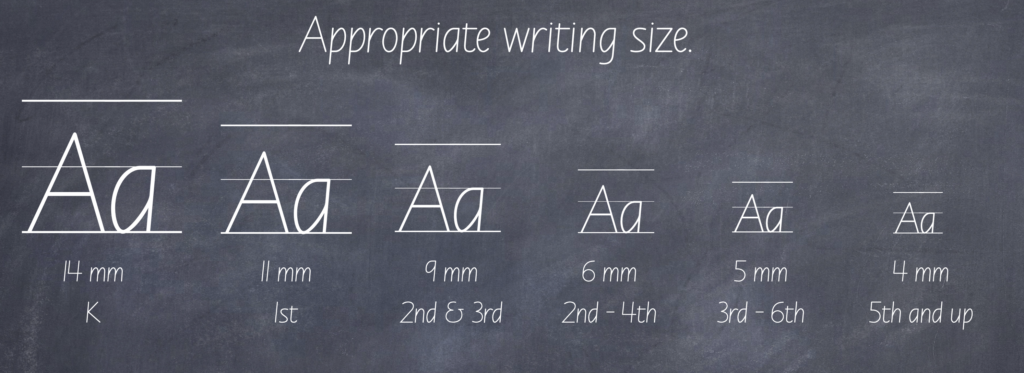
Regarding letter height preference, the idea of the larger letters is so that students can actually see and control the letterforms as they write. It is helpful and important, at times, to have students write even bigger, on sand/shaving cream trays, on big sheets of paper on the wall, or in the air. It helps especially with stroke sequence — the “pen path” of the letter.
The authors Getty and Dubay have worked with thousands of students, and consulted with many teachers. These writing sizes in the Getty-Dubay® Italic Handwriting Series are optimized for the developmental skills commonly found at these grade levels.
When the authors worked with doctors, helping them write more legibly, they had the doctors writing 3-foot-high letters in the air. They weren’t happy about it at first, but did what they were asked, and realized in the end it made their handwriting better.
Sometimes a students will state that the letter height in their workbook is not appropriate for them. Students at the age of 10-13 start writing VERY small, for some reason. It could be an effort toward fluency. Giving students ownership over their writing is important, so do offer them opportunities to write at the size they choose.
The writing size in the Getty-Dubay® Italic Handwriting Series Books A-G doesn’t mean that all the student’s writing at that age has to be that size. Yes, you can have the student use lined paper, where the ruled lines are the baseline and the waistline, and then skip at least a line so that the ascenders and descenders don’t collide. You can also use our DIY Worksheet Generator to produce lined paper of any practical size. Read more about using lined paper.