• Skip to primary navigation
  • Skip to main content
  • Skip to primary sidebar

We're now accepting
orders through government funding programs
such as ESAs and charter schools.
Please read the instructions
prior to placing your first order.
To avoid delays, please order
ONLY
through our 
Government Funding Programs Collection.

Placing an order through an ESA or charter program? Click here to get started!
web home logo3 reverse
web home logo3 small device reverse
  • About
    • About Us
    • In the Press
    • Testimonials
  • Handwriting
    • Italic Handwriting
    • For Kids
    • For Adults
    • Why Cursive?
    • Why Italic?
    • Italic Handwriting Samples
  • Calligraphy
    • Why Calligraphy?
    • Italic Calligraphy
    • For Kids
    • For Adults
    • Pens
    • Italic Calligraphy Samples
  • Products
    • All Getty-Dubay Products
    • App
    • Write Now
    • Italic Handwriting Series
    • Italic Letters
    • Italic Calligraphy for School and Home
    • Materials for Teachers
      & Homeschool
    • Fonts
  • Resources
    • Free Training & Tools
    • Book Selector
    • Handwriting Tips
    • FAQs
    • Handwriting Standards
    • Style Comparison
    • Contact Us
  • News
  • Shop
    • Shop Workbooks & Materials
    • Purchase through a Government Funding Program
    • School Orders
    • Shop Fonts
    • Shop Pens
    • Find a Store

News

State Handwriting Standards Resource

January 17, 2026 by hsadmin

New Online Resource Reveals Where Handwriting Instruction Is Required in U.S. Schools

Contrary to the common perception that handwriting has vanished from American classrooms, most U.S. states require handwriting instruction in public schools, according to a new nationwide online resource. The findings show that a majority of state education departments mandate handwriting instruction through at least third grade, with some extending requirements through sixth grade and beyond.

The interactive resource, published by Handwriting Success, provides the first comprehensive, state-by-state overview of handwriting education standards and related legislative mandates across all 50 states. It arrives as public debate around handwriting instruction often resurfaces ahead of National Handwriting Day, observed annually on January 23, the birthday of John Hancock.

The new database allows parents, educators, policymakers, and journalists to easily compare handwriting requirements across states. It is available at:
https://handwritingsuccess.com/handwriting-standards/

“Despite ongoing debate, there has never been a single, reliable online source that clearly showed where and how handwriting is addressed in state education standards,” said Jonathan Dubay, CEO of Handwriting Success. “Neither the U.S. Department of Education website nor other national organizations had made this information readily available online. We reviewed every state department of education website, along with relevant legislative sources, to create an accurate, transparent, and easy-to-use reference.”

Unlike other websites that focus only on legislative mandates, the Handwriting Success resource includes both education content standards and laws, with direct citations and links to original sources. The interactive map makes it easy to see how individual states compare nationwide.

“The Handwriting Success interactive map of state standards offers priceless data for everyone who cares about the future of handwriting,” said Kate Gladstone, author of READ CURSIVE FAST and International Director of the World Handwriting Contest. “Handwriting Success has a strong reputation for providing objective, accurate, and up-to-date information.”

While the database documents what states require, it does not measure how handwriting is actually taught in classrooms or how effective current instruction may be. “That’s the missing piece,” Dubay said. “We look forward to the day when data on classroom practice and outcomes become widely available.”

Research continues to explore best practices in handwriting instruction. Recent validation of a 1985 study suggests that instruction using an italic handwriting style may support stronger long-term retention than looped cursive styles. (https://handwritingsuccess.com/new-reasearch-validation-suggests-benefit-of-italic/)

“In today’s classrooms, written expression remains a cornerstone of student achievement,” said Kathleen Wright, Executive Director of The Handwriting Collaborative, a nonprofit organization focused on best practices in handwriting education. “Effective instruction depends on understanding how handwriting aligns with state standards. This interactive map gives educators across the country a valuable and practical curriculum resource.”

Handwriting Success publishes the Getty-Dubay® Italic Handwriting Series for grades K–6, created by educators and handwriting experts Barbara Getty and Inga Dubay. Developed in 1979, the curriculum is designed to promote early handwriting fluency and legibility while eliminating the need for students to relearn letterforms when transitioning from print to cursive. The Getty-Dubay® curriculum is available as physical workbooks and as an app for tablet and stylus.

Getty and Dubay have also applied their expertise beyond the classroom, training more than 4,500 physicians in improved handwriting during medical clinic visits across the United States. Their work has been featured nationally, including a 2009 New York Times op-ed that invited readers to practice handwriting directly on the page.

For more information and to explore the interactive handwriting standards map, visit https://handwritingsuccess.com/handwriting-standards/. Read the press release.

Filed Under: News

National Handwriting Day 2026

December 30, 2025 by hsadmin

To Celebrate National Handwriting Day, Handwriting Success is sponsoring four Handwriting the Constitution events at local libraries. The Multnomah County Library is inviting the public to come together quietly to copy the United States Constitution by hand at four events at four libraries: Gresham Library, Hillsdale Library, Albina Library and Northwest Library. Dates, locations and information here.

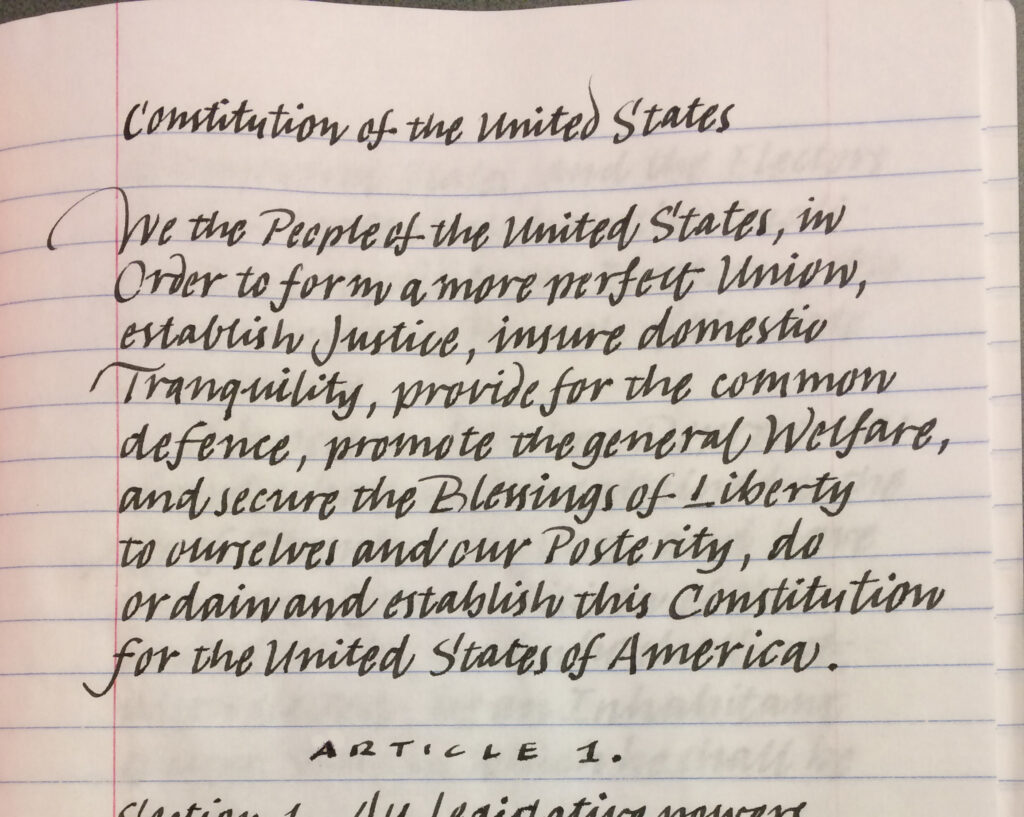
Handwriting the Constitution is an opportunity for reflection on the meaning and content of this foundation of self-governance, using tools that are available to all of us: pen and paper. Free copies of the U. S. Constitution will be available for all participants. Participants are asked to bring a writing tool and paper (some paper and pens will be on hand). A free “Handwriting Tips” informational sheet will also be available. This Multnomah County Library Event is a partnership between Handwriting the Constitution and Handwriting Success, which is sponsoring this event by providing materials and staff and is part of the Multnomah County Library Everybody Reads Program.

Handwriting the Constitution events were conceived in 2017 by artist Morgan O’Hara. More information about Handwriting the Constitution and Morgan O’Hara can be found at https://www.handwritingtheconstitution.org/.

See the press release.

Filed Under: News

Capitals and ascenders — how high?

November 19, 2025 by hsadmin

Sometimes people ask why Getty-Dubay® Italic capital and ascender height is different from that of continuous looped cursive styles.

There are three reasons: Historical, practical and aesthetic.

Historical

Getty-Dubay® Italic is a modern version of the Chancery style from the Italian renaissance. The first-ever printed instruction book in handwriting that we know of is Arrighi’s L’Operina from 1522. You can see in this image below that the capital height, although variable, is generally 1.5 times the height of the lowercase letters (what we call the body height). The ascender height, however, varies from 1.5 to many times the body height, depending on the amount of flourish.

Over the last 500 years, practitioners of the Italic style have offered varying views about what constitutes correct ascender height (1.5 or 2x), while mostly agreeing on the size of capitals as 1.5x the body height.

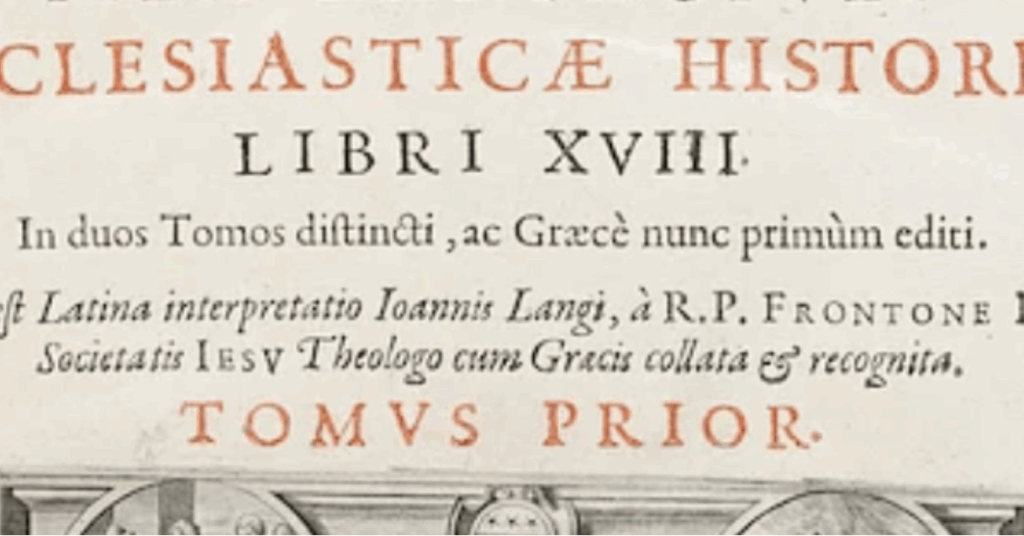
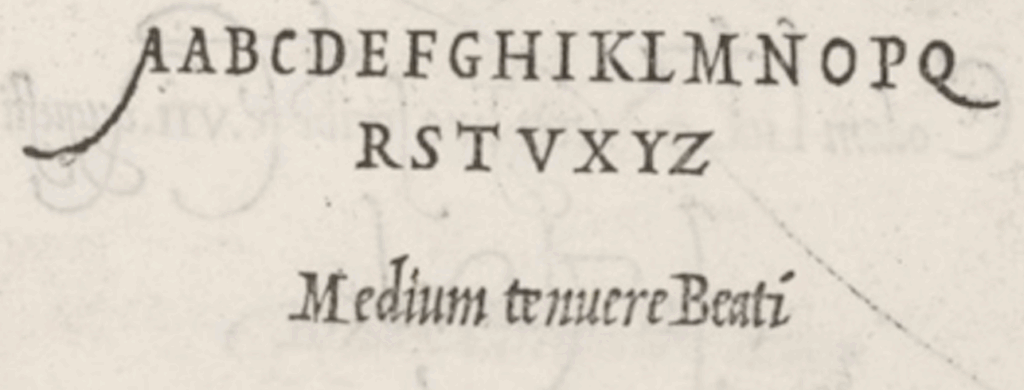
Typographers, however, have followed the model set forth by Renaissance type designers, where the Roman capitals conform to the 1.5x rule, and ascenders do the same, as in this example from 1555 of Handbook of the Christian Soldier by Desiderius Erasmus.

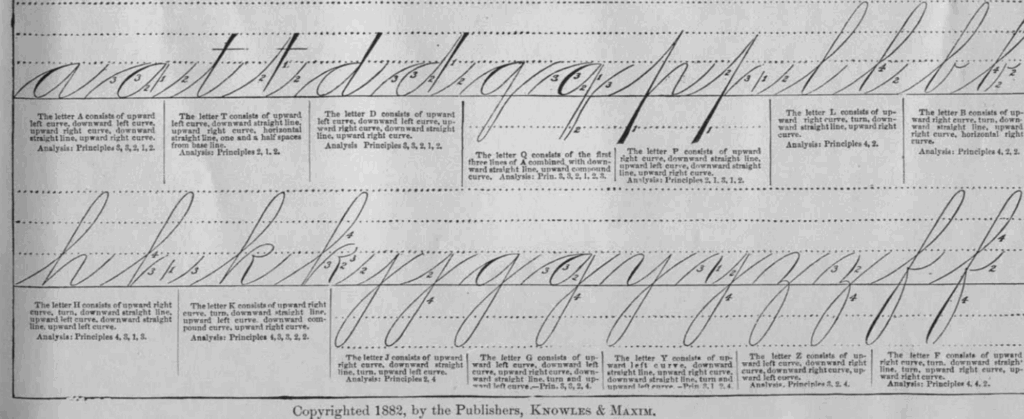
In the 19th century, in Spencerian instruction books, such as the one pictured here, from 1881, we begin to see ruled lines and other directives. In this example, the ruled lines indicate a 3x ascender height for some letters, a 2x ascender on ‘p’, and capital letters as much as four times the body height.

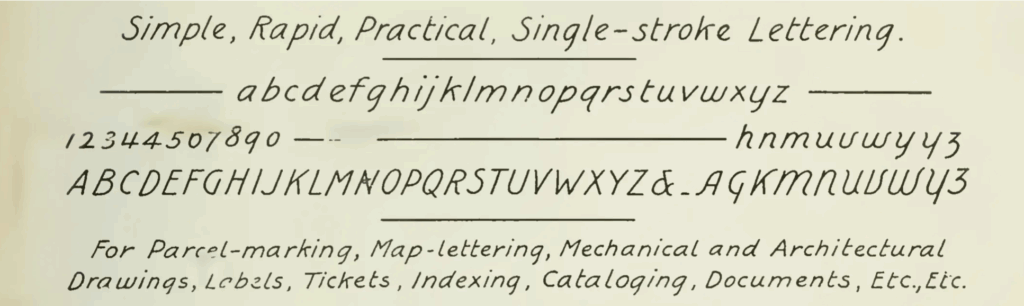
Meanwhile, lettering styles took their cue from typography. You can see in this lettering exemplar by Zaner & Bloser (1904) that the recommended capital and ascender height are similar to type.

Practical

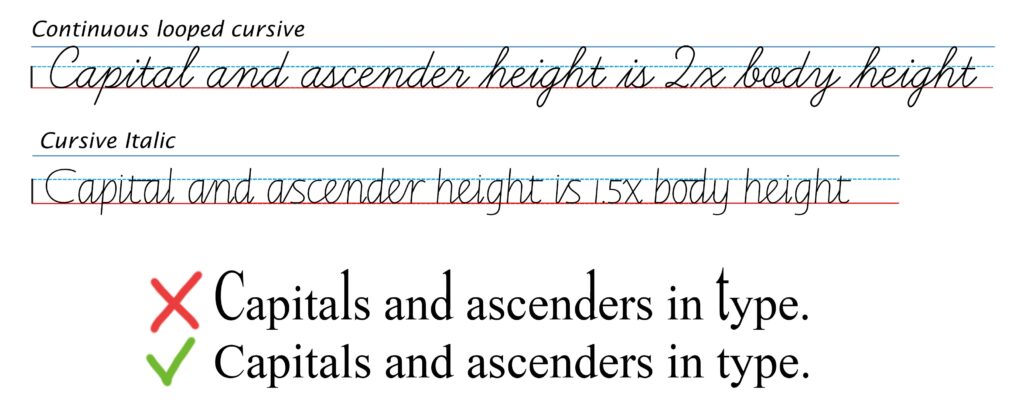
One of the goals of Getty-Dubay® Italic is legibility. Legibility is accomplished by avoiding loops, and using letterforms that are generally similar to those of type. This graphic shows how long ascenders and tall capitals typically do not occur in type. Why not? Because we read form the tops of letters. If the ascenders take too much visual attention away from the body of the letter, it slows our reading speed. Loops also interfere. 

What about the ‘t’? Isn’t that an ascender, too? Actually, it isn’t. Historically, ‘t’ originated from the Roman capital ‘T’. Look at the typeface above and you’ll see that the top of the ‘t’ extends only a little bit above the waistline. If it extends too high, it could be confused with other similar letters (such as ‘f’ or ‘l’).

Another reason: People tend to exaggerate the size and shape of ascenders and descenders when writing quickly or expressively. Sometimes this can result in the body of letter — the part that contains the most important information — becoming a tiny boat on a sea of loops and curlicues.

Another unwanted result of exaggerated ascenders and descenders is that a line of writing is more likely to run into and obscure the next line with tangled loops and capitals (on the right-hand side of the image.)

Aesthetic

One of the hallmarks of the Italic style is the beauty of the letterforms. Most of the lowercase letters in the Italic style share the golden ratio (1.618…) with each other. For example, the width of the ‘a’ multiplied by the golden ratio equals its height. The same goes for every letter except ‘i’, ‘j’, ‘l’, ‘m’, and ‘w’. Long ascenders and descenders can over-balance the body of the letter, looking awkward or excessive.

You are certainly welcome to make your handwriting personal, expressive, and unique. But do remember that when you want someone else to be able to read your handwriting, you need to give them enough to go on — such as clear and uncluttered tops of letters —  and not too many distractions.

Filed Under: FAQs

Constitution Day 2025

September 5, 2025 by hsadmin

We’re partnering with
Handwriting the Constitution
for National Constitution Day, 2025

At Handwriting Success, we are celebrating Constitution Day on September 17, 2025 by joining the ongoing events of Handwriting the Constitution. (Read the NYTimes.com story here.) Find out more about this non-profit organization created by Morgan O’Hara, and organize your own event www.hanwritingtheconstitution.org.

See below the event that is being sponsored by Handwriting Success in collaboration with Handwriting the Constitution. It is free and open to the public. Spend quality time getting to know this foundational document of self-governance by copying it out by hand, either at this event, on your own or in a group, in public or in private.

You can find out more about how to participate, or create your own local event at www.handwritingtheconstitution.org.

Handwriting the Constitution for Constitution Day event:

Wednesday, January 22, 5:30pm to 7:30pm. Multnomah County Library Midland Branch, 805 SE 122nd Avenue in Portland, Oregon. More information and updates: https://multcolib.org/events-classes/handwriting-constitution

Press Release

A PDF of the complete up-to-date text of the U. S. Constitution can be found here.

Filed Under: News

Getty-Dubay Italic has earned the 2025 Modular Learning Award

January 11, 2025 by hsadmin

Getty-Dubay® Italic has been selected as a 2025 Modular Learning Award winner!

This recognition is part of Modulo’s 2025 Guide to Homeschooling Programs, which features 1,000 carefully vetted resources across 116 categories. The award highlights the very best programs that meet the highest standards for homeschooling families, including:

  • Uniquely innovative and not designed just for test prep.
  • Kids love them and find them highly engaging.
  • Error-free and grounded in accuracy.
  • Foster critical thinking without hidden bias or indoctrination.
  • Secular and welcoming to all families.
  • Built on thoughtful, child-centered pedagogy.
  • Encourage self-directed learning and exploration.
  • Highly recommended by families with domain expertise and personal experience.

Getty-Dubay® Italic stood out among tens of thousands reviewed, reflecting its exceptional quality and impact on learners. The 2025 2025 Guide to Homeschooling Programs is designed to be a trusted resource for families navigating the ever-growing world of homeschooling programs, showcasing outstanding options like Getty-Dubay® Italic.

Learn more at https://www.modulo.app/all-resources/homeschooling-programs-2025.

Filed Under: News

Handwriting Day 2025

January 7, 2025 by hsadmin

We’re partnering with
Handwriting the Constitution
for National Handwriting Day, 2025

Every year, on John Hancock’s birthday, the United States celebrates the amazing cultural phenomenon of handwriting. Handwriting communicates — it expresses ideas, emotions, thoughts, instructions. Handwriting organizes — by making lists, plans, goals. Handwriting teaches — it helps us to learn and to think. And it connects us to thousands of years of cultural history.

There are many ways to celebrate Handwriting Day, and they all involve exercising that basic literary skill that you probably don’t remember learning for the first time. You can write a letter, postcard, or just a note to a friend or family member — a thank you, a get-well-soon, a love letter or a business letter. You can learn a new handwriting style, or brush up the one you use. You can write out your favorite poem, quotation, or document.

At Handwriting Success, we are celebrating Handwriting Day 2025 by joining the ongoing events of Handwriting the Constitution. (Read the NYTimes.com story here.) Find out more about this non-profit organization created by Morgan O’Hara, and organize your own event www.hanwritingtheconstitution.org.

See below the event that is being sponsored by Handwriting Success in collaboration with Handwriting the Constitution. It is free and open to the public. Spend quality time getting to know this foundational document of self-governance by copying it out by hand, either at this event, on your own or in a group, in public or in private.

You can find out more about how to participate, or create your own local event at www.handwritingtheconstitution.org.

Handwriting the Constitution for National Handwriting Day event:

Wednesday, January 22, 3pm to 5:30pm. Multnomah County Library Hillsdale Branch, 1525 SW Sunset Boulevard, Portland, OR 97239. More information and updates: https://multcolib.org/events-classes/handwriting-constitution

Press Release

A PDF of the complete up-to-date text of the U. S. Constitution can be found here.

Filed Under: Handwriting, News

Next Page »

Primary Sidebar

Topics

  • Calligraphy
  • FAQs
  • Handwriting
  • Help Desk
    • — For Adults
    • — For Students
  • News
    • New Products

Latest

  • State Handwriting Standards Resource
  • National Handwriting Day 2026
  • Capitals and ascenders — how high?
  • Constitution Day 2025
  • Getty-Dubay Italic has earned the 2025 Modular Learning Award
  • Handwriting Day 2025
  • New FREE letter-tracing apps
  • Help Desk: Edged pen writing for lefties
  • Help Desk: What flavor “pizza”?
  • Handwriting Success Hailed as One of the Best Educational Apps for Kids

Contact us |  App Support | Product Support

Join us!
Sign up for news and offers via email
and get 10% off your next purchase.

Join our mailing list

Join us! Sign up for news and offers via email. Privacy Policy


Please verify that you are human.


When you complete the signup, you'll get an email with a discount code for 10% off Getty-Dubay® books and materials (new signups only, other exclusions apply).


About
Getty-Dubay History

Media

Handwriting
For Kids
For Adults
Why Handwriting?
Why Italic?
Why Cursive?

Why Calligraphy?
Calligraphy
For Adults

For Kids
Pens
Calligraphy Examples

Products
App
Write Now
Italic Handwriting Series
Italic Letters
Italic Calligraphy for School and Home
Materials
Fonts
Gift Cards
Greeting Cards & Pens

Resources
DIY Worksheets & Videos
Handwriting Tips
Book Selector
FAQs
Pen Choices
Style Comparison

Contact Us
Find a Store
Product Support
App Support
School Orders

  • About
    • About Us
    • In the Press
    • Testimonials
  • Handwriting
    • Italic Handwriting
    • For Kids
    • For Adults
    • Why Cursive?
    • Why Italic?
    • Italic Handwriting Samples
  • Calligraphy
    • Why Calligraphy?
    • Italic Calligraphy
    • For Kids
    • For Adults
    • Pens
    • Italic Calligraphy Samples
  • Products
    • All Getty-Dubay Products
    • App
    • Write Now
    • Italic Handwriting Series
    • Italic Letters
    • Italic Calligraphy for School and Home
    • Materials for Teachers
      & Homeschool
    • Fonts
  • Resources
    • Free Training & Tools
    • Book Selector
    • Handwriting Tips
    • FAQs
    • Handwriting Standards
    • Style Comparison
    • Contact Us
  • News
  • Shop
    • Shop Workbooks & Materials
    • Purchase through a Government Funding Program
    • School Orders
    • Shop Fonts
    • Shop Pens
    • Find a Store

Follow us

Publisher: Handwriting Success, LLC, Portland, OR USA
Distributor: Allport Editions, www.allport.com, 1.800.777.2844, Portland, OR USA


© 2020 Handwriting Success. All Rights Reserved.
Getty-Dubay® is a USPTO registered trademark.
Privacy & Legal